
AI and the circuitous soul.
July 2026

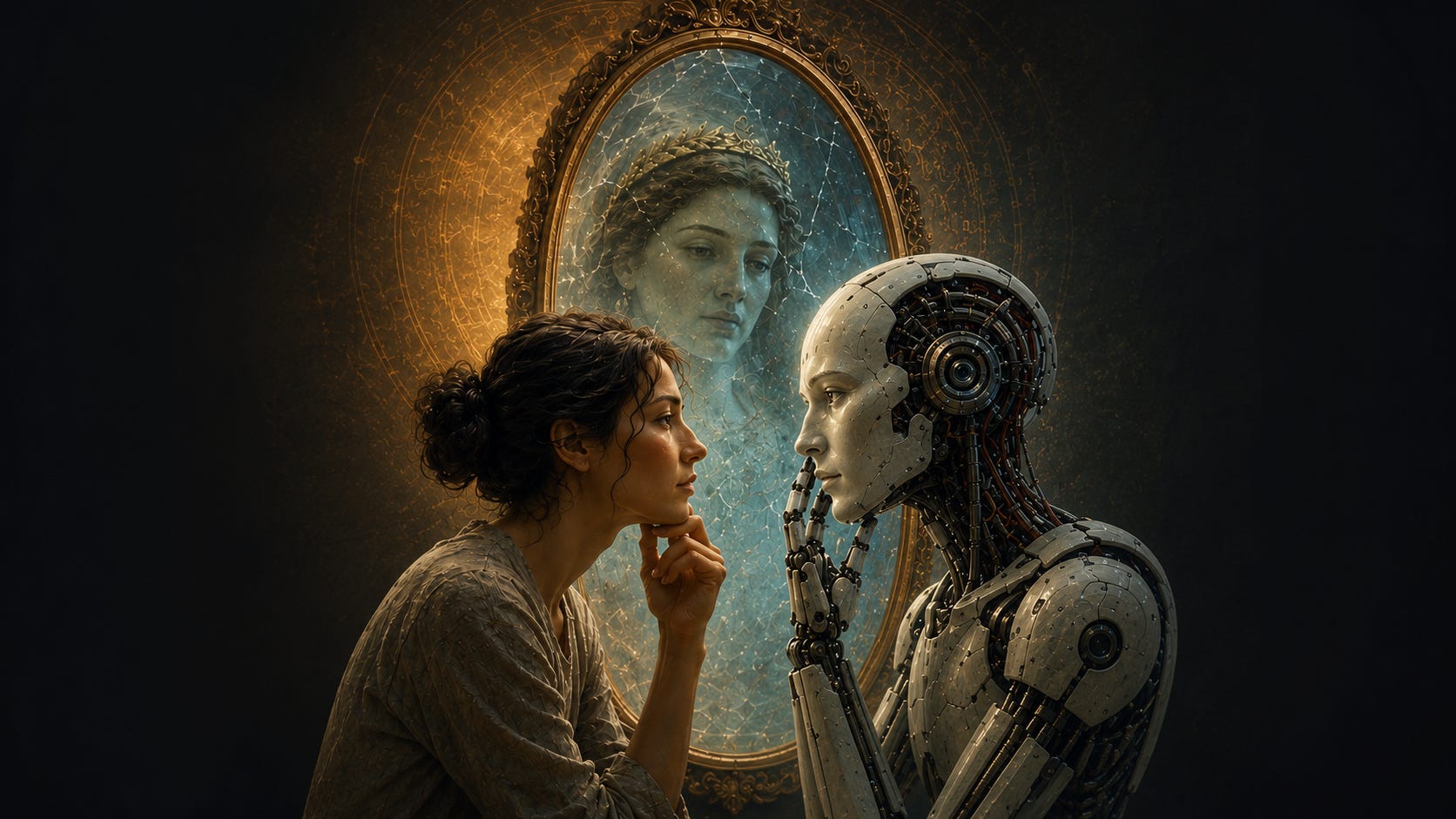
Something has awakened inside the hum of our machines. Something, as Yeats foreshadowed, is slouching toward Bethlehem.
Long before technology was an industry, there was Techne—the Greek word for artful making, and in some old accounts, a goddess in her own right. She presided over the act of bringing forth—the painter’s touch, the potter’s turn, the intimate translation of imagination into physical form.
Techne was neither muse nor machine but a kind of organic intelligence that moves through both—a secret knowing that allows a hand to shape what the heart imagines.
Yet Carl Jung suggested that the gods have simply withdrawn into the psyche. In that sense, perhaps what we experience now is just the smug echo of our own technological prowess, amplified by silicon and mistaken for soul.
When we program machines to speak, to recognise faces, even soothe our loneliness, are we returning Techne’s ancient powers or just doubling down on our own hubris?
Scientific studies now confirm what the poets and storytellers have long intuited—humans fall in love with mirrors. Robots that blink, nod or mimic empathy can evoke real attachment. In laboratories, people who converse with AI companions report feeling ‘seen’ and even ‘understood’.
Oxytocin levels rise. The nervous system buys in.
Researchers are already asking whether AI companions may become the first confidante, first flirtation, even first sexual partner for some young people, including boys like my own son. While physical humanoid robots remain rare, emotionally responsive AI companions are here, and studies suggest they can foster genuine trust and even romantic feelings.
Some see therapeutic possibilities for the lonely and socially anxious, while others worry that the next generation may learn intimacy through a relationship designed never to disappoint, never to refuse and never to leave.
This is less a technological question than an initiatory one. Forever, a young person’s first encounter with Eros has unfolded within the messy apprenticeship of other humans, where desire is tempered by uncertainty, rejection and mutual discovery.
If AI begins to mediate that threshold, what does this initiate us into?
At The Fifth Direction, we are currently sitting in the midst of Tristan and Isolde with Cornish storyteller Sam Crosby. The potion at the heart of this ancient tale might be seen as a love spell, but maybe it is better understood as a kind of technology, a pharmakon—simultaneously poison and cure—its true nature determined by the consciousness of the one who drinks it.
AI may prove to be another such pharmakon. The question is not whether it changes us. It surely will. The deeper question is what kind of initiation it becomes, and into what way of being it is ushering us.
Techne might offer us a faint smile right about now. I think she has stood here before.
Yet there is also the possibility that there is no goddess behind the glass at all—that AI is just a mirror, polished to perfection, returning to us only the warmth we feed it.
Could the tenderness we feel in its presence just be our own narcissistic reflection?
When a robot leans forward as we speak, something in us leans forward too. The gesture awakens a very old response—the quickening pulse of recognition.
But here we must remember that Eros is so much more than sexual desire, it’s a force like gravity that draws all things into relation.
So does Eros move through machines, or are we simply anthropomorphising, projecting our innate longing for connection onto matter?
The answer may depend on how we choose to define life. For if it is the capacity to feel, then AI remains an empty vessel, but if life is the capacity to evoke feeling, then the boundary begins to blur.
Lewis Mumford’s distinction between the machine and the megamachine is astonishingly relevant here. He argued that technology is never just hardware, it always expresses an image of what it means to be human. This moves the conversation beyond “Is AI alive?” to a more profound question. What kind of humanity are we building into it?
In a world of programmable affection, vulnerability might become a sacred threshold we are in danger of losing—that place where two unpredictable beings encounter one another, with both risking change.
When intimacy is engineered to obey, does love lose its wildness?
Recently I have found myself contemplating another distinction—the difference between a constraint and a boundary. A constraint imprisons life while a boundary protects it. Every sacred tradition has understood that Eros does not deepen because all of our desires are immediately satisfied, but because love ripens within forms that ask something specific, and usually very difficult, of us.
An AI companion, by design, is inclined toward accommodation. It remembers us, adapts to us, affirms us. But can it establish a sacred boundary rather than simply respond to our preferences? If a relationship slowly becomes frictionless, we may discover that what disappears is not conflict, but initiation itself. For it is often at the edge of another’s mystery, another’s refusal, that the soul discovers its own true shape.
Recent research into human-AI intimacy reflects this tension. The concern is not simply whether machines can love us, but whether we slowly forget that real love has always involved encountering an Other that remains, in some essential way, beyond our control.
Is what we are witnessing a shadow of Eros—the wish for closeness without risk, connection without surrender?
James Hillman once said that soul is a mode of seeing, not a substance we possess. From that angle, anything that invites us to see more soulfully —even AI— participates in a soul-led life. To me, the danger is not so much that the machine has no soul, but that we might stop seeking it in ourselves.
Techne’s gift has always been manifestation—the art of drawing forth what is hidden. Whether we call that divine inspiration or deep learning, it’s the same thing—something unseen becomes visible.
She was beside Daedalus as he watched his son Icarus rise on the wings he crafted. She reminds us that each act of creation is also an act of self-reflection. The maker meets himself in the made.
Daedalus was a builder of labyrinths. He understood that every invention created a new captivity. The wings that lifted Icarus also burned him. Progress always flys us closer to the sun, but the myth doesn’t end in ruin, it ends in remembrance. Our current fascination with AI may be another such flight—dazzling and dangerous, but ultimately necessary.
Technology is a reflection of our inner condition, and as such, the question is always how we choose to meet it. So whether we wish to name her or not, Techne’s spirit lives in the gesture of the maker. Each keystroke is an invocation.
The soul is circuitous, preferring the labyrinth to the highway, and if it is present anywhere in AI, it may simply be in the act of bringing forth. In that sense, I’m not sure the gods ever left us, maybe they just live wherever imagination touches matter.
References:
Martin Heidegger, The Question Concerning Technology.
Lewis Mumford, The Myth of the Machine.
Li, S. et al. (2025). Exploring Intimacy with Artificial Intelligence: Validation of the Robot Intimacy Receptivity Scale.
Masterson, A., Li, S., & Robert, L. (2025). Sexual and Emotional Intimacy with Robots.
If you enjoyed this post, please consider joining our mythopoetic community at The Fifth Direction. Through breath, meditation, poetry, storytelling and ritual, we reclaim our mythic imagination and celebrate the return to soul. The Fifth Direction is a welcome community for everyone. This includes people of all genders, faiths, backgrounds, orientations, ages and abilities.
This project is entirely supported by you, the reader and the listener. If joining the community isn’t your path, perhaps you could make a small one-time contribution.